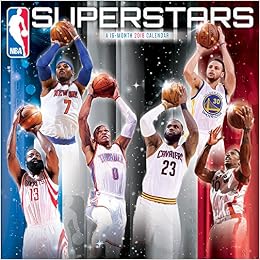
 |
| SOURCE: https://www.amazon.com/NBA-Superstars-2018-Wall-Calendar/dp/1438853106 |
The economic principle I’m exploring is “Because of scarcity, people choose. All choices have an opportunity cost.”
My research question to help me study the economic principle is “What makes an NBA player considered a superstar, and how high is the demand for these types of players?”
The article published in Upprox by author Gabe Bain titled “Defining An NBA Superstar” demonstrates this economic principle because it defines what it means to have a superstar status and discusses their value in relation to other players, as well as gives several examples of current NBA superstars and explains why.
As discussed in the last article, teams in the NBA always have a “core” that is essentially the foundation of their offense/defense, and usually consists of at least 3 good, versatile, reliable players. These players do not need to be stars, like Steph Curry, but rather people that simply understand the game and can lead a team to victory. Everyone these days tends to think that if a team doesn’t have any famous superstars, then they have no chance of winning the championship, let alone even getting that far in the first place. But what’s the big deal? What’s the big talk around all these so-called ‘superstars’? More importantly, what does it take for a player to be labeled as a ‘superstar’?
After scrolling through many different articles, I’ve found that there is no set definition for an NBA superstar. It is rather a collection of many different beliefs and ideas that are commonly shared and agreed upon amongst people, although it still varies slightly from person to person. Everyone has their own definition of a superstar. However, most people agree upon a majority of factors that determine whether or not an NBA player is a superstar.
As Bain asserts in his article, a superstar “is someone who can have a team built around him. He should be able to take them deep into the playoffs and be that guy you can depend on in the closing minutes.” As mentioned in the previous blog post and supported by author Matt Moore, many teams tend to revolve their game around their star players, or essentially “build the team” around them. This is a key feature of an NBA superstar; not only having the team built around them, but being able to use that advantage to take them to the playoffs, and ultimately the championship. Take LeBron James for example. This is the most obvious example of a current NBA superstar. He has lead his team to three titles, and gotten them to the playoffs every year since 2011. When he left the Cavs for the Heat, the Cavs didn’t even make the playoffs the following year. Then, when he eventually left the Heat, after winning a championship with them, they couldn’t even make it out of the second round. This is because both the Cavs and the Heat built their game strategy around LeBron. The majority of their plays revolved around him and setting him up for opportunities, and they utilized him in multiple different positions, both on offense and defense, in order to make the most out of him. From many different sources, this seems to be the defining feature of an NBA superstar. They need to be a good, smart, leader that can have a team built around them and be able to consistently lead that team to victory. The last thing Bain suggests is that a superstar need be consistent, meaning that if he achieves this status, it must be for a long period of time. It can’t just be for a year or two, because anyone could get lucky or have a couple good year. If they show consistency, Bain says, then “they have sustained streak of greatness over more than just a couple of years.” It seems pretty reasonable. Obviously people are not going to call a rookie a superstar, even if he is fantastic, because they have not seen any consistency over the short time that they have been in the league. Someone like Tim Duncan, though, who has been in the league for 20 years and had many historical achievements and successes, could definitely be considered a superstar.
Lastly, Bain says that the demand for these is extremely high, although they almost never tend to get traded. LeBron James, Kevin Durant, Steph Curry, Chris Paul… How often does anyone ever see these players being traded? Very little. This is because as stated, their teams have already built around these players, and so getting rid of them would change their entire strategy and most likely ruin their chemistry. Bain says, “A GM would literally break his arm before trading a superstar. And if he was traded, the other team would have to give up everything including the kitchen sink to acquire him.” This highlights how valued these players are, and it has proved to be true as seen in the past. When Derrick Rose was traded to the Knicks, he was traded for three top-pick rookies, which was basically everything the Knicks had at that point. But now that they have Rose, who is already a highly valued, trusted player, they can build their team around him and potentially be more successful in the future.

No comments:
Post a Comment